Friday, February 28, 2025

Paul's March 2025 Fly of the Month

 Coyote Micro Dace


Hook:  Size #8 - #12 4X Long Streamer Hook.

Thread:  Black 6/0.

Body:  Silver or Holographic Silver Tinsel.

Belly:  White Bucktail.

Wing:  Coyote Fur over Black Bucktail.

Head:  Black Thread coated with Head Cement, Hard As Nails, or UV Resin.

While many fly fishers out there have concentrated on tying large articulated streamers in search of big trout, personally I’ve taken a different approach, tying and fishing smaller ones.  Many times, tied on a jig hook.  This fly is more of a traditional ‘New England’ type streamer.  Just tied on smaller size hooks.  I think the reason I’ve gone with smaller streamers is that it’s easy to fish them with small changes to my ‘euro-rigs’ on a lighter rod. 

To tie this fly, start your thread an eye length or two behind the eye and wrap back down to the bend.  Bring your thread back up to the tie in point.  You are now ready to tie in your Silver Tinsel body. Tie it in at your initial ‘tie-in’ point, wrap down to the bend, then back up to the ‘tie-in’ point.  Now make touching wraps up the hook shank.  Tie it off and cut off the butt end.  Traditional New England streamers are tied this way so that an even and slender body is created.

Next, prepare a small bunch of White Bucktail for your belly. The belly and wing materials should be on the sparser side.  Do not overdress this fly. To tie in the belly, invert the fly if you have a rotary vice, or do it manually. Tie it in under/behind the eye. It should extend approximately 2 hook gap lengths behind the bend.  Once secured you can cut off the butt end of the belly. Invert your fly again and tie in a small bunch of Black Bucktail for the first layer of your wing.  It should mirror the lower belly that you just tied in. Once affixed you can clip off the butt end and ‘clean up’ the fly head with thread wraps. 

Finally, prepare a bunch of Coyote Fur for your top wing.  Again, don’t overdress your fly.  The Coyote should have a mix of long guard hair as well as some under fur. Tie it in on top of your Black wing. Cut off the butt end and create a nice little head on the fly with your black thread. Whip finish it, cut your thread, and finish the head with head cement or UV resin. Your fly is done. One final note here. You could substitute other natural furs for the top wing, but I really love using coyote.  It not as stiff as Bucktail or as flaccid as squirrel.  Coyote has the perfect mix of stiffness and movement that makes this streamer attractive to fish.

Savage Flies has a great video on how to tie this fly below:

If you have any questions about this fly or would like to submit a Fly of The Month I can be reached at pdinice@frontier.com .

Sunday, January 26, 2025

Paul's February 2025 Fly of the Month

 Grass Monkey

Hook:  Mustad 34007 Size #1.

Thread:  Black 8/0.

Eyes:  Medium Bead Chain or Nickle Dumbbell eyes.

Body:  Regular Size Estaz Tan Chenille.

Wing:  Olive Green or Tan Craft fur with stripes marked with a Permanent  Marker.

Flash:  Two strands of Gold Krystal Flash on each side of the wing.

Top Wing/Head:  Deer Hair with spun Head.

Why post this fly for the Fly of the Month since it was originally created for warm water species, like redfish, in southern waters?  I’ve posted it because it’s a great ‘Cross Over’ fly that works well for stripers.  It’s very similar to ‘kwan’ flies in that it can imitate a shrimp, a crab, or even a bait fish.  I’ve caught stripers on it.  Given it to friends that have fished Florida & Puerto Rico, and they caught a wide variety of species on it. 

To tie this fly, debarb your hook and place it in your vice.  You are going to mount your bead chain or dumbbell eyes approximately 1/3 down the hook shank.  Use

‘cris cross’ and figure 8 wraps to secure it to the hook.  I like to place a drop or two of UV Resin on my wraps to secure it firmly to the hook shank.  Next, bring your thread all the way back to the bend.  Tie in your Estaz Tan Chenille.  Palmer the Estaz forward with touching wraps, stroking the fibers backwards as you go.  Tie it off behind the eyes and cut off the excess. 

Now invert your fly in the vice.  Prepare a pencil size clump of Craft Fur for your wing.  Tie it in front of the eyes with securing wraps.  Smooth out the base taking into account tying in some Deer Hair for the top wing.  Using a magic marker, bar the Craft Fur wing.  Next, on each side of the Craft Fur Wing, tie in 2 pieces of Crystal Flash.  They should extend at least to the tip of the wing.  Prepare a chunk of Deer Hair fibers for your Top Wing.  Clip it from the hide and strip out the guard hairs and short fibers.  The Top Deer Hair wing should extend at least to the hook point.  Hold it in place on top of the Craft Hair wing.  Take 2 loose wraps and then tightly pull down to flair the butt end of the Deer Hair.  Wrap through your butts a few times with your thread.  Pull all the butts rearward and make some securing wraps in front of the deer hair.  Whip finish the fly.  While holding your Deer tips down, Trim down the butt ends of the Deer Hair to create a small circular head.  I add a drop of head cement to my Deer Hair head for extra durability. 

Trident Fly Fishing has a great video on how to tie this fly below:


If you have any questions about this fly or would like to submit a Fly of The Month I can be reached at pdinice@frontier.com .


Sunday, January 5, 2025

Paul's January 2025 Bonus Fly of the Month

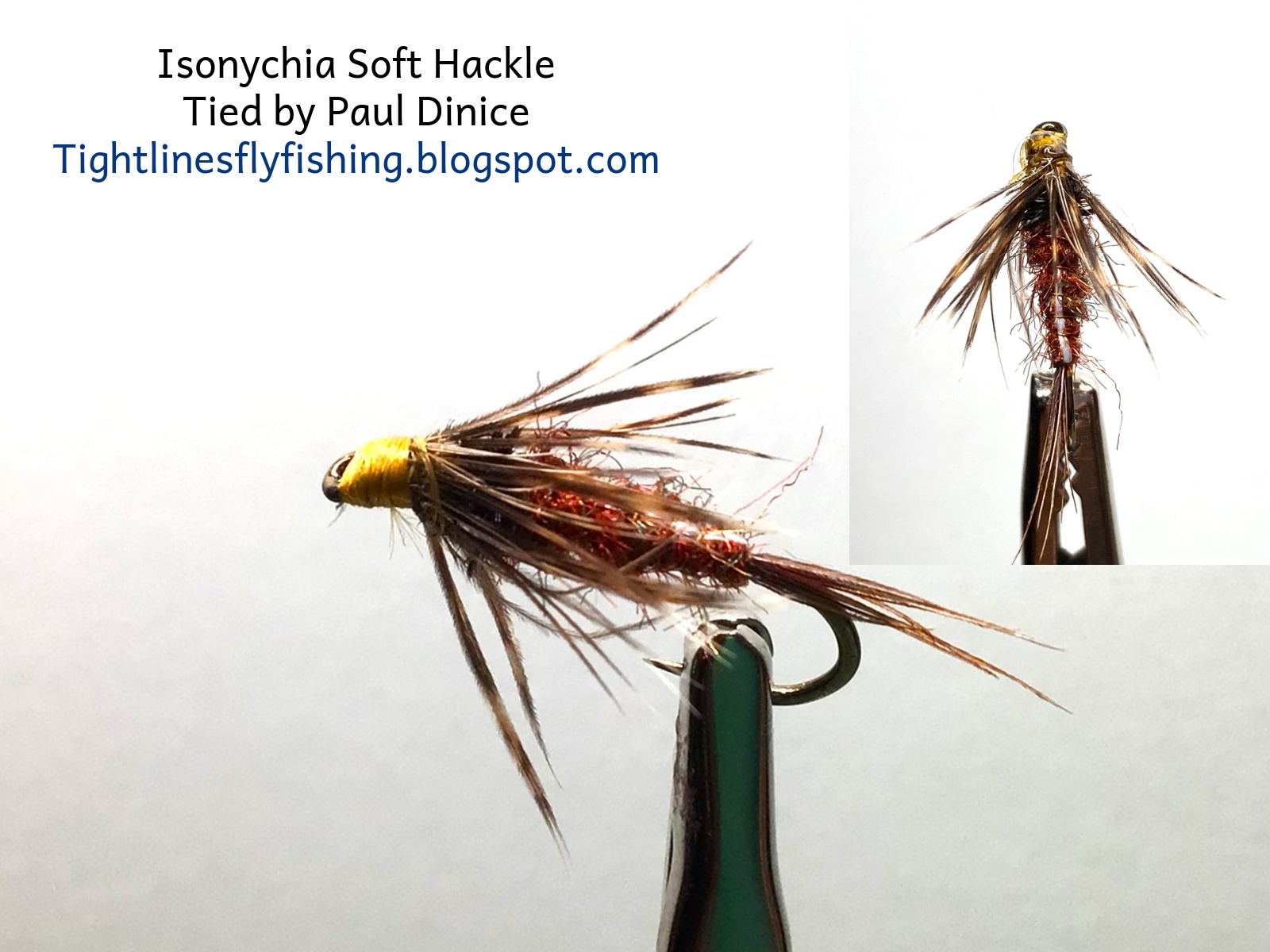
 Isonychia Wet Fly


Hook:  Fulling Mill 5085 Nymph Hook, Size #12.

Thread:  UTC Brown or Wood Duck 70 denier.

Rib:  Small Gold Ultra Wire.

Tail:  6-8 Pheasant Tail Fibers.

Dorsal Stripe:  White UTC 140 Denier Thread or White Floss.

Abdomen:  Isonychia-colored Dubbing.

Thorax:  Peacock herl 3-4 strands.

Collar:  Hen Feather, mottled brown.

If you’re a fly-fisherman here in CT, you should carry a ‘life cycle’ of Iso patterns in your fly box.  Why?  Because it’s a big fly and can be found on the water from late spring to mid fall.  How big is this fly?  Usually around a size #12 to #14.  I’ve previously featured Iso flies by Preston Jennings as the ‘Fly of the Month’.  This pattern is a variation of his flies. 

To tie this fly, debarb your hook and place it in the vice.  Start your thread with securing wraps a ‘hook eye’s length’ behind the hook eye.  Cut off the butt end of your thread.  Tie in your Gold Wire Rib and make touching wraps rearward.  Wrap down to the bend of the hook.  Next, advance your thread to the original ‘tie in’ point of your thread.  Prepare a half dozen or so Pheasant Tail Fibers for your tail.  The tips should be evenly aligned.  Tie them in for your tail.  They should be approximately a hook gap in length.   Bind them down on top of the hook shank wrapping rearward.  Once secured bring your thread up to the mid-point of the hook shank. 

Tie in your White Thread Dorsal Stripe.  Wrap your rearward to secure it, making sure you keep it on top of the hook shank.  Next, dub a slim Dubbing Noodle of your Iso Dubbing.  Dub the body up the hook shank to your initial tie in point.  Next, pull your white thread over the top of the body and secure it with a few wraps.  Cut off the excess thread.  Next, make open spiral wraps up the body with your Wire Ribbing to create a segmented body.  Tie it down and ‘helicopter’ off the wire.


Next, tie in 3-4 strands of peacock herl for your thorax.  Take 3-4 turns around the hook shank.  Remember to leave room for your Collar/Hen Hackle.  Secure it with a couple wraps of thread and cut off the excess.  Next, prepare your mottled brown hen hackle for your Collar.  Ideally, the fibers on the hen feather should be approximately a hook shank in length.  Strip off the lower fibers on the feather stem.  Holding the tip of the feather in 1 hand, strip the lower fibers rearward.  Snip off the tip of the feather and then tie it in right behind the eye of the hook.  Take 2 wraps of your hackle and secure it behind the eye.  Anchor the stem behind the eye.  Snip off the excess stem.  Make a few more wraps to preen back any forward pointing fibers.  Whip finish your fly.  Apply some head cement if you desire.   

Tightlinevideo has a great instructional video below: 


 If you have any questions about this fly or would like to submit a Fly of The Month I can be reached at pdinice@frontier.com .


Thursday, December 26, 2024

Paul's January 2025 Fly of the Month

 Dirty Hipster Nymph


Hook:  Ahrex FW555 or Jig hook of choice Size #14

Bead:  Mottled Brown Slotted Tungsten Bead or Bead of Choice.

Weight:  (Optional) .015 lead free wire.

Tail:  Brown Hen Feather Fibers.

Hot Spot:  Orange or Red Glow Brite Floss or Thread.  Then coated with ‘Bone Dry’ UV Resin.

Thread:  140 Denier Thread in Olive or Brown or Wood Duck.

Rib/Flash:  Small Pearlescent Tinsel or Krystal Flash.

Body:  Hare’s Ear Dubbing.

Legs: Rubber. Legs.

Collar:  Mix of Dark Antron & Hare’s Ear Dubbing.

The Dirty Hipster was originally tied by a gentleman named John Newbury.  It is really a version of a Hare’s Ear Nymph on steroids. It has a ‘Hot Spot’, Flash, and rubber legs to help induce strikes.  You can tie it with various colors of Hare’s Ear.  It’s one of my favorite subsurface ‘Attractor/Searching’ patterns. 

To tie this fly, debarb your hook, place your bead on it, and put the fly in the vice.  Next, take a length of lead-free wire and make 10-12 touching wraps around the hook shank.  Push it up against your bead.  Start your thread behind the wire wraps to lock it in place.  Cover your wraps with thread leaving your thread down near the bend.  Tie in 3-4” of Floss.  I like to put my hot spot just below the hook shank under where my tail will be placed.  Once you create your hotspot, cut off the butt end of the floss and coat the ‘Hot Spot’ with UV Resin.  I like to use ‘Bone Dry’ for this.  Next, take 8-10 Brown Hen Fibers and tie it in for your tail.  It should be approximately a hook gap in length.  Next, tie in your Pearlescent Tinsel or Krystal Flash.

Now, create a thin Dubbing Noodle of Hare’s Ear, color of choice.  Dub a thin body leaving a small space behind the bead for your Legs & Collar.  Tie off your Dubbing Noodle and prepare 2 pieces of Rubber Legs for your nymph.  They should be at least 2” in length.  They will be trimmed when the fly is finished.  Tie them in at the mid-point, behind the bead, on each side of the nymph.  Adjust them so that they form a symmetrical X on the fly.  Next, dub a small noodle of Dark Antron & Hare’s Ear Dubbing.  With your noodle, take a wrap behind the legs, in the middle of the legs, and in front of the legs to form a dark collar.  Whip-finish your fly behind the bead.  Now trim your legs to form a symmetrical X.  I trim the rear legs so that they are in line with the length of the tail.  The front legs should be trimmed so that they are slightly shorter.  Your fly is finished.

Below is a video from The Fly Smith/ties flies on how to tie the Dirty Hipster:

If you have any questions about this fly or would like to submit a Fly of The Month I can be reached at pdinice@frontier.com .


Wednesday, December 4, 2024

Paul's December 2024 Bonus Fly of the Month

 Polecat Panfish Fly


Hook:  Mustad 3906b or Nymph Hook of preference Size #6 - #12.

Thread:  Black 6/0.

Weight:  (optional) .015 Lead Wire, 15 to 20 wraps.

Tail:  Black Marabou.

Legs:  Round Rubber Legs.

Under Body:  Wrapped Medium Yellow Chenille.

Fly Back:  Large Black Chenille.

I love fishing for ‘pan’ fish.  Its a lot of action and fun, and you can really hone in on your casting and ‘setting’ skills.  When you don’t have much time or want to travel far, head to your local pond and get away from it all.

To tie this fly, crush down the barb and place your hook in the vice.  If you want to weight your fly, take 15-20 wraps of wire around the hook shank, centering the wraps in the center of the hook shank.  Now start your thread behind the eye, take some securing wraps and then wrap down & over the lead wraps to the bend of the hook.  Wrap back and forth over the lead wraps.  End your thread back down at the bend.  Prepare a tuft of Black Marabou for your tail.  Preen and stroke the Marabou fibers back and tie it in at the bend.  Use spiral wraps up the hook shank to secure the fibers to the hook shank.  End behind the eye and cut off the butt end of the Marabou. 

Bring your thread back down to the bend to tie in your body.  Tie in a strand of Black Chenille.  Over that tie in a strand of Yellow Chenille.  When tying in these strands I strip off some of the material from the center core.  Next, bring your thread to the half-way point of the hook shank.  You are going to tie in your Rubber legs.  There will be a pair of legs on each side of the fly.  Take 2 strands of Rubber legs approximately 1 ½” long and secure them to the top of the hook shank with 2-3 wraps.  Now adjust the legs so that you have a pair on each side of the hook shank forming a ‘V’ on each side.  Now wrap your Yellow Chenille up the hook shank, wrapping it behind, in the middle, and in front of the legs all the way to the hook eye.  Tie off your Yellow Chenille and cut off the butt end.  Bring your Black Chenille over the top of the hook shank to create your ‘fly back’.  Tie it off at the eye of the hook and cut off the butt end.  Create a small head, whip finish, and apply a drop of head cement. 

 Dressed Irons has a great video on how to tie this fly below: 

If you have any questions about this fly or would like to submit a Fly of The Month I can be reached at pdinice@frontier.com .

Saturday, November 30, 2024

Paul's December 2024 Fly of the Month

 Hen & Copper

Hook:  Wet Fly/Sprout Hook Size #14 to Size #18.

Thread:  140 Denier Thread in Olive or Brown or Wood Duck.

Body:  Copper Ultra Wire Brassie.

Thorax:  Peacock Herl 3-4 strands.

Collar:  Pheasant Feather or Hen Feather, mottled brown.

This is a great ‘attractor’ fly.  For myself, and some of my friends, it has been one of the hot flies on the upper Housatonic this Fall (2024).  Most fly shops don’t sell wet flies, and on the rare occasions when they do, you won’t find a fly like this.  The copper wire gives it a flash in the water and helps keep your fly a little lower in the water column.  When I tie it to smaller sizes, I don’t even put a Thorax on it.  I also prefer to use Hen feathers for those smaller wets.  I also don’t rib it.  You might also want to tie it on a variety of different hooks.  Pictured here are a couple variations of this fly.

To tie this fly de-barb the hook and place it in your vice.  Start your thread behind the eye and take a half dozen securing wraps.  Cut off the butt end.  Next, tie in 2 strands of copper wire.  Tie them in about an ‘eye’ length behind the eye.  Once secured, start wrapping down the bend making ‘side by side’ wraps.  Wrap down to the bend in the hook.  Now palmer your wires forward with spiral wraps to create a rib.  When you reach your wire tie in point, tie it off, and ‘helicopter’ off the butt ends.

Next, tie in 2 strands of Peacock Herl.  Take 4-5 wraps to create a ‘balled’ thorax.  Tie off the peacock and cut off the butt ends.  Next, prepare your hen feather for your collar.  Strip off the fuzzy end of the feather.  Now pull 1 side of your feather fibers off the stem.  Doing this resolves the problem of putting too much hackle on your fly.  Stroke the remaining fibers back except for the very tip of the feather.  Tie the feather by the tip with securing wraps.  Cut off the butt end (tip) of the feather.  Take 3-4 wraps of the feather to create your collar.  Tie the feather off.  Cut off the butt end.  Create a finished head with your thread.  Whip finish, cut off the butt end, and apply a drop of head cement if you so desire.  

Holsinger's Fly Shop has an excellent video on how to tie this fly below:


If you have any questions about this fly, or would like to submit a fly of the month, I can be contacted at pdinice@frontier.com .

Saturday, November 9, 2024

Paul's November 2024 Bonus Fly of the Month

 Crab Pot Fly


Hook:  Gamaktsu SL12S Size 1/0.

Thread:  Mono or Olive  6/0.

Mouth: Olive Craft Fur.

Claws:  Barred Olive Hackle.

Body:  Olive SF Blend or EP Fibers or Congo Hair

Eyes:  Burnt Mono.

Weight:  Medium Dumbbell eyes.

Legs:  Olive Sili Legs.

This is an essential fly here in New England. Crabs are a substantial part of the stripers diet, yet many don’t fish crab flies.  Part of the problem is not knowing where & when to fish them.  I fish a few different crab flies, but this is the most productive of all of them.  The color can also be modified to match the bottom environment.  The size can also be varied depending on the size of crabs the bass are feeding on.  When fishing a crab fly, keep it in the ‘zone’ a lot longer than you would a bait fish.  Make sure it gets down.  If you strip it, short intermittent strips with pauses can induce strikes.  When tying this fly I usually add some head cement or UV Resin on my wraps to enhance its durability.

To tie this fly begin by placing your fly in the vice.  Start your thread at the bend of hook and secure it with 9-10 wraps.  Cut off the butt end.  Prepare a ½ ‘pencil’ sized clump of craft fur for the mouth of the fly.  Tie it in at the bend of the hook.  It should extend approximately a hook shank length beyond the bend.  Next, tie in your mono eyes.  You can either purchase them or make them by burning the ends of heavy mono line.  When you tie them in, make sure they splay outward.   They should extend halfway down the Craft Fur Mouth at the bend of the hook.  When tying them in remember that this fly will fish with the hook up.  The eye should be pointed up slightly.  Once they are secured, cut off the excess.

Next, with a few strands of your EP Fibers or Congo Hair, create a short dubbing noodle on your thread.  Dub a small ‘ball’ around the hook shank at the tie in point at the bend.  Select and prepare 2 feathers for the claws of the crab.  Keep in mind that for a ‘green’ crab, 1 claw is larger than the other.  Both claws should splay outward and slightly ‘upward’, approximately a ½ hook shank length beyond the Craft Fur mouth.  Cut off the butt ends and cover your securing wraps with another dubbing noodle on your thread. 

You are now going to tie in a tuft of EP/Congo Fibers under the hook shank, over the claws and eyes.  It should be approximately a pencil in thickness and extend ‘upward’ and beyond the bend to the eyes.  Once secured and the butt end is trimmed, prepare another tuft of Fibers to begin to form your crab body.  The length should measure at least 1 ½ inch on each side of the crab (to be trimmed later).  Secure the Fibers, laying 1 side along the hook shank, take securing wraps, and sweep rearward.  Now take the other side of the Fibers and place them over the hook shank, sweeping them rearward on the other side of the hook.  Secure the Fibers with some wraps.  Repeat this process up the hook shank.  It may take 4-5 tufts of Fibers to complete the body.  Remember to leave room behind your hook eye for your Dumbbell Eyes.  Once your Fiber body is completed, tie in your Dumbbell Eyes behind the eye of the hook (Reverse your hook in the vice and mount them on what is normally the top of the hook shank).  Use figure 8 wraps to make sure they are secure.

Next, behind the Dumbbell Eyes, tie in 4 Silly Legs (again, on what is normally the top of the hook shank).  Once secure, bring your Silly legs over the Dumbbell Eyes to the other side of the hook shank.  At the same tie in point on the opposite side of the hook shank, secure them with thread wraps.  They should extend approximately to the Claw tips on what will be the bottom of your fly.  Finally, behind the Dumbbell Eyes and Leg tie in point, add 1 more tuft of EP/Congo Fibers on each side of the hook shank.  Whip finish your fly and add some cement to your wraps.

Now it’s time to trim your crab.  Begin by preening out your EP/Congo Fibers.  With your scissors round out the edges of your crab to create a semi-circle on each side of the hook.  Advice in trimming your Crab Fly—Take your time.  It’s better to trim off a little at a time than too much at once.  Please be careful so that you don’t trim off any of your legs or claws.

 Maine Fly Guys have an excellent video on how to tie this fly below:


If you have any questions about this fly or would like to submit a Fly of The Month I can be reached at pdinice@frontier.com .